
Views: 0 Author: Site Editor Publish Time: 2026-07-16 Origin: Site


Selecting the right thermal spray system is rarely a simple purchasing decision. Facility limitations heavily dictate the required technology. Target coating specifications like porosity and bond strength also shape your choices. Production volume further narrows down the available options. You need precise control to succeed. Procuring mismatched equipment leads to excessive consumable costs. It also causes high reject rates and facility compliance violations. A poor equipment choice jeopardizes your entire production line. We will detail the distinct categories of systems a specialized manufacturer offers. You will discover the supporting infrastructure required for safe and compliant operations. Finally, we provide the evaluation criteria necessary for a defensible procurement decision. Choosing between high-velocity setups and atmospheric plasma requires careful analysis. We explore how to align your specific material feeds to the correct torch technology. By understanding these variables, you ensure optimal coating performance.
Equipment ranges from high-deposition arc spray systems for corrosion control to precision plasma systems for thermal barriers.
A complete system requires peripheral integration, including robotics, mass flow controllers, and specialized dust collection.
Evaluating a manufacturer requires assessing not just the torch technology, but their ability to support facility integration, OSHA/NFPA compliance, and operator training.
Proof-of-concept (PoC) testing with your specific substrates and powders is a mandatory step before final shortlisting.
Operations must shift their focus away from baseline capital expenditure. You should evaluate cost-per-coated-part and overall system uptime instead. High efficiency demands reliable equipment running continuously. Frequent breakdowns halt production lines and inflate operational expenses. Manufacturers define uptime using mean time between failures (MTBF). Ask vendors to supply verified MTBF data for their core components. This approach ensures you choose a robust system capable of meeting daily production targets.
You must match equipment directly to your intended feedstocks. Feedstocks include specialized wires, fine powders, and liquid suspensions. Each material requires distinct operational temperatures to melt properly. Particle velocities also determine how the material impacts the substrate. A reputable Thermal Spray Equipment manufacturer will cross-reference your required coating materials against their torch capabilities. Mismatched materials cause excessive clogging and poor coating adhesion.
Different production environments require vastly different automation levels. Job shops typically rely on manual or semi-automated setups. These environments handle varied parts and require high flexibility. Aerospace and automotive OEM production demands fully automated, closed-loop systems. Mass production requires strict process repeatability. Closed-loop systems monitor gas flows and adjust parameters in real time. Differentiating your exact volume needs prevents under-equipping or over-engineering your facility.
Operations utilize arc spray equipment primarily for high deposition rates. This technology excels at large-area corrosion protection using zinc or aluminum. Facilities also use it for rapid dimensional restoration on worn components. When evaluating this technology, you must scrutinize power supply stability. Wire-feed reliability is equally critical to prevent sputtering. Inconsistent wire feeding directly causes extended downtime and uneven surface finishes.
HVOF systems create extremely dense, low-porosity coatings. Industries specify these systems for applying tungsten carbide and achieving severe wear resistance. You must evaluate liquid fuel versus gas fuel configurations carefully. Liquid fuel often yields higher particle velocities. However, gas fuel setups can offer easier facility integration. Always scrutinize the associated cooling requirements. Fuel delivery safety mechanisms require strict verification before final procurement.
APS systems handle high-temperature ceramics and thermal barrier coatings (TBCs). This technology generates extreme temperatures necessary for melting refractory materials. Buyers must closely assess cathode and anode lifespan claims. Consumable wear directly impacts your daily operational efficiency. You should also verify the precision of the mass flow controllers (MFCs). These controllers manage critical plasma gases like Argon, Hydrogen, and Helium. Imprecise gas control ruins coating integrity.
Flame spray represents a lower-velocity application method. Facilities use it for abradable coatings or manual repair work. It remains highly effective for less demanding dimensional restoration. Safety remains a primary concern for this older technology. You must insist on high-quality safety flashback arrestors. Evaluate whether manual or automated gas control panels best suit your operators. Automated panels reduce human error during ignition and shutdown procedures.
| Technology | Primary Application | Feedstock Type | Key Evaluation Metric |
|---|---|---|---|
| Arc Spray | Corrosion protection, dimensional repair | Conductive wires | Wire-feed reliability |
| HVOF | Severe wear resistance, low porosity | Powder | Fuel delivery safety |
| APS (Plasma) | Thermal barrier coatings (TBCs), ceramics | Powder | MFC gas control precision |
| Flame Spray | Abradable coatings, manual repairs | Wire or Powder | Flashback arrestor quality |
Thermal spray processes generate hazardous noise levels. HVOF and plasma systems often exceed 110 decibels during operation. Manufacturers supply sound attenuation booths to manage these extreme decibel levels. These enclosures protect operators from permanent hearing damage. They also shield personnel from dangerous UV radiation generated by plasma plumes. Operating high-velocity systems outside a rated acoustic booth violates basic occupational safety standards.
Manual spraying cannot achieve aerospace-grade consistency. Modern systems require seamless integration of 6-axis robots. Facilities pair these robots alongside synchronized turntables or lathes. This integration guarantees a consistent standoff distance between the torch and the part. It also ensures perfectly maintained traverse speeds across complex geometries. Precise motion control eliminates human fatigue and guarantees coating repeatability.
Spraying metals creates hazardous, highly combustible dust. Standard facility HVAC systems cannot safely manage this particulate matter. You need NFPA-compliant wet or dry dust collectors. Engineers design these collectors specifically for reactive metal dusts like aluminum or titanium. Proper extraction prevents catastrophic facility fires. It also maintains a clean operating environment essential for high-quality coating adhesion.
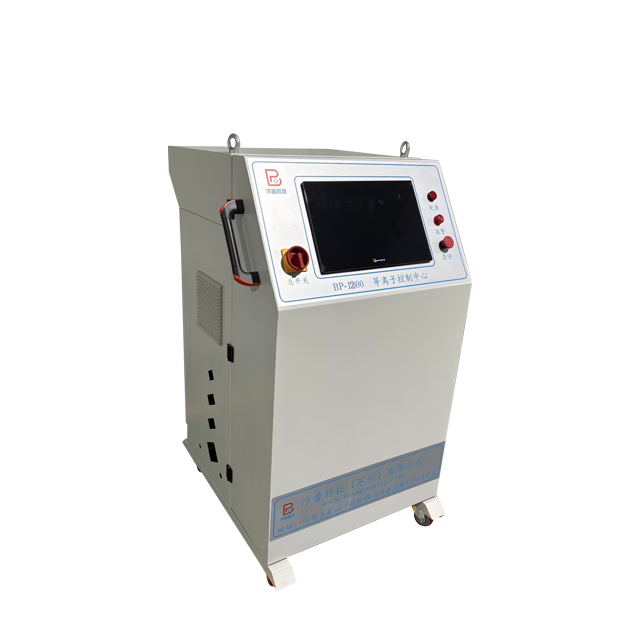
Advanced operations require PLC-based control interfaces. These consoles provide real-time monitoring of all process parameters. They log data continuously to ensure strict process repeatability. Aerospace compliance frameworks, such as Nadcap, mandate comprehensive data logging. Closed-loop systems detect minor gas flow deviations instantly. They adjust the parameters automatically to prevent rejected batches.
Calibrate mass flow controllers every six months to maintain compliance.
Install dedicated blast gates on all exhaust ductwork for proper airflow balancing.
Position the robot controller outside the acoustic booth to protect sensitive electronics from metal dust.
Use interlocked door sensors to instantly shut down the torch if personnel enter the booth.
Facilities often start with lower production volumes and scale up over time. You must ask if the system allows future upgrades. Can you upgrade a manual gas panel to a fully automated PLC later? A modular system lets you expand without replacing the core power supply. This flexibility preserves your initial capital investment. Manufacturers offering modular designs demonstrate a commitment to your long-term operational growth.
You must request the manufacturer's data on deposit efficiency (DE). Deposit efficiency measures how much material actually adheres to the substrate versus how much bounces off. High DE reduces your ongoing feedstock consumption. Furthermore, you need to track torch component wear rates. Nozzles and electrodes degrade rapidly under high thermal loads. Evaluating these wear rates helps you accurately project monthly maintenance budgets.
Avoid buying disjointed components from multiple unaligned vendors. Assess the manufacturer’s ability to act as a comprehensive systems integrator. They must combine the torch, robot, and exhaust into a single safety-interlocked cell. A unified cell communicates seamlessly across all components. If a robot faults, the torch should instantly extinguish. True integrators take responsibility for the entire cell's performance.
Equipment must meet strict regional and international safety standards. Verify the presence of CE marking for European operations. North American facilities require UL or CSA approvals on all electrical panels. Equipment must also adhere to local environmental regulations regarding emissions. A reliable manufacturer provides a comprehensive documentation package. This package proves compliance during external facility audits.
| Component | Basic Setup | Fully Automated Setup | Upgrade Path Complexity |
|---|---|---|---|
| Gas Control | Manual rotameters | Closed-loop MFCs | High (Requires new console) |
| Part Handling | Manual lathe | Synchronized 6-axis robot | Moderate (Requires floor plan changes) |
| Data Logging | Paper logs | PLC automated logging | High (Requires software integration) |
Buyers frequently underestimate facility utility requirements. High-velocity and plasma systems draw massive electrical currents. You must verify if your building can support high-amperage power drops. Additionally, these torches require industrial cooling water chillers to prevent meltdowns. Undersizing a chiller causes frequent thermal shutdowns. High-pressure gas bulk storage is also mandatory. You need secure exterior pads for liquid oxygen or argon tanks.
Sophisticated spray equipment requires highly specialized training. A standard machine operator cannot safely run a plasma cell on day one. You must assess the manufacturer's onboarding protocols. Request access to their troubleshooting manuals before purchase. Evaluate their ongoing technical support service-level agreements (SLAs). Strong technical support prevents minor faults from becoming week-long production delays.
Accessibility of wear parts dictates your long-term operational success. Evaluate whether the manufacturer relies entirely on proprietary consumables. Proprietary parts often carry long lead times and disrupt production schedules. Standardized consumables offer better availability. Check the physical design of the torch. Operators should be able to swap nozzles or electrodes in minutes, not hours. Complex teardowns lead to severe maintenance bottlenecks.
Failing to test local water hardness before connecting industrial chillers.
Placing gas control panels too far from the torch, causing pressure drops.
Ignoring the need for dedicated, climate-controlled powder storage rooms.
Delaying operator training until the equipment commissioning phase begins.
Never purchase a system based purely on glossy spec sheets. You must require the manufacturer to spray sample coupons. They should use your exact parameters and desired feedstocks. Once sprayed, conduct independent metallurgical lab testing. Verify porosity and bond strength against strict ASTM standards. Proof-of-concept testing validates the equipment's capability objectively. It eliminates guesswork before finalizing any procurement decision.
Scrutinize the fine print on warranty void conditions carefully. Some vendors void warranties if you use third-party powders. You must understand these restrictions upfront. Furthermore, evaluate the guaranteed response time for field service engineers. An equipment failure requires immediate attention. A vendor promising a four-week dispatch time is unacceptable for continuous production lines. Demand a clear SLA for on-site repairs.
Consolidate your exact requirements into a standardized Request for Quotation (RFQ). This document forces an apples-to-apples vendor comparison. A vague RFQ yields wildly different proposals. Your document must be highly specific.
Detail your exact footprint constraints and ceiling heights.
Specify the required daily throughput and part dimensions.
List the precise material specifications and standards you must meet.
Define your exact automation and data-logging expectations.
Sourcing thermal spray equipment remains a complex exercise in risk mitigation and careful facility alignment. You cannot simply compare spec sheets to find the optimal solution. Your facility utilities, automation needs, and target coating standards must align perfectly. We strongly recommend partnering with a manufacturer that transparently addresses your facility constraints. They should offer verifiable component lifespans. Most importantly, they must insist on pre-purchase application testing to prove their capabilities. Secure your production quality today. Schedule a detailed technical consultation with a qualified equipment provider. Request a custom proof-of-concept trial to validate your specific coating parameters before making a final commitment.
A: Arc systems require standard heavy-duty electrical drops and compressed air. Plasma systems demand significantly more infrastructure. They require massive high-amperage power drops, exterior bulk gas storage for Argon and Hydrogen, and high-capacity industrial chillers. Plasma also requires superior acoustic booth isolation due to higher operational decibel levels.
A: Yes. Advanced manufacturers offer multi-process controllers. These sophisticated PLC consoles manage both HVOF and plasma parameters from a single interface. The facility can use a shared acoustic booth, robotic arm, and dust collector. Operators simply swap the physical torch on the robot wrist and select the corresponding software profile.
A: Installation and commissioning typically require 12 to 24 weeks. This timeline depends heavily on custom engineering requirements and facility readiness. Pouring new concrete pads, upgrading electrical drops, and installing ductwork take significant time. The final commissioning phase alone often takes two weeks to calibrate robotics and verify safety interlocks.
A: Many manufacturers offer their own OEM consumables, but they are not the sole source. You can often use third-party feedstocks. However, you must clarify compatibility directly with the equipment builder. Using non-approved materials can impact component wear rates and may void specific warranties on the torch internals.


